
DHAN-VYAPAR

Canara Bank launches loan products to meet shortfall in hospitalisation expenses Know Details Here

[ad_1]

Canara Bank News Update: अगर आपके या परिवार में किसी सदस्य के अस्पताल में इलाज के दौरान मेडिक्लेम की लिमिट कम पड़ जाए तो आपको अब फिक्र करने की जरूरत नहीं है. बैंक से लोन लेकर आप अस्पताल के बचे हुए बिल का भुगतान कर सकते हैं. सार्वजनिक क्षेत्र की केनरा बैंक ने बुधवार को एक ऐसा लोन स्कीम लॉन्च किया है जिसमें अस्पताल में इलाज के दौरान पैसे कम पड़ जाने के बाद आप बैंक से लोन ले लेकर बिल का भुगतान कर सकते हैं.  

इस लोन स्कीम को लॉन्च करते हुए केनरा बैंक ने बताया कि हेल्थकेयर फोकस्ड लोन प्रोडक्ट का नाम केनरा हील (Canara Heal) है. इस लोन प्रोडक्ट का मकसद अस्पताल में इलाज के दौरान पैसे कम पड़ जाने की स्थिति में लोन देकर अस्पताल के बिल का भुगतान करना है. बैंक ने अपने स्टेटमेंट में बताया कि ये लोन अस्पताल में इलाज के लिए भर्ती होने के दौरान सेल्फ या डिपेंडेंट के टीपीए हेल्थकेयर इंश्योरेंस क्लेम के जरिए सेटलमेंट किए जाने के दौरान पैसे कम पड़ जाने पर बैंक लोन देकर बचे हुए रकम का भुगतान करेगी. 

केनरा बैंक ने बताया कि अस्पताल के बचे हुए बिल का भुगतान करने के लिए फ्लोटिंग बेसिस पर 11.55 फीसदी के दर पर लोन मिलेगा. जबकि फिक्स्ड रेट के हिसाब से लोन लेने पर 12.30 फीसदी पर बैंक लोन देगी. ये हेल्थकेयर लोन फैसिलिटी उन कस्टमर्स के लिए है जिनके इलाज का खर्च इंश्योरेंस लिमिट से ज्यादा है. 

केनरा बैंक ने महिलाओं के लिए केनरा एंजेल नाम से सेविंग अकाउंट प्रोडक्ट को लॉन्च किया है जिसमें कैंसर केयर पॉलिसी जो यूनिक फीचर से लैस है. इसमें प्री-अप्रूव्ड पर्सलन लोन की सुविधा है साथ ही टर्न डिपॉजिट पर ऑनलाइन लोन लेने की भी फैसिलिटी उपलब्ध है. महिलाओं के लिए ये सेविंग अकाउंट पूरी तरह फ्री ऑफ कॉस्ट है साथ ही बैंक की मौजूदा महिला ग्राहक अपने अकाउंट्स में इन फीचर्स को जोड़ने के लिए अकाउंट को अपग्रेड करा सकती हैं. 

ये भी पढ़ें 

UPI Update: डिजिटल पेमेंट का सिरमौर बना यूपीआई, 2023 की दूसरी छमाही में 100 लाख करोड़ रुपये तक पहुंचा ट्रांजैक्शन

[ad_2]

Investment mantra: How much should you allocate to small-cap funds?

[ad_1]

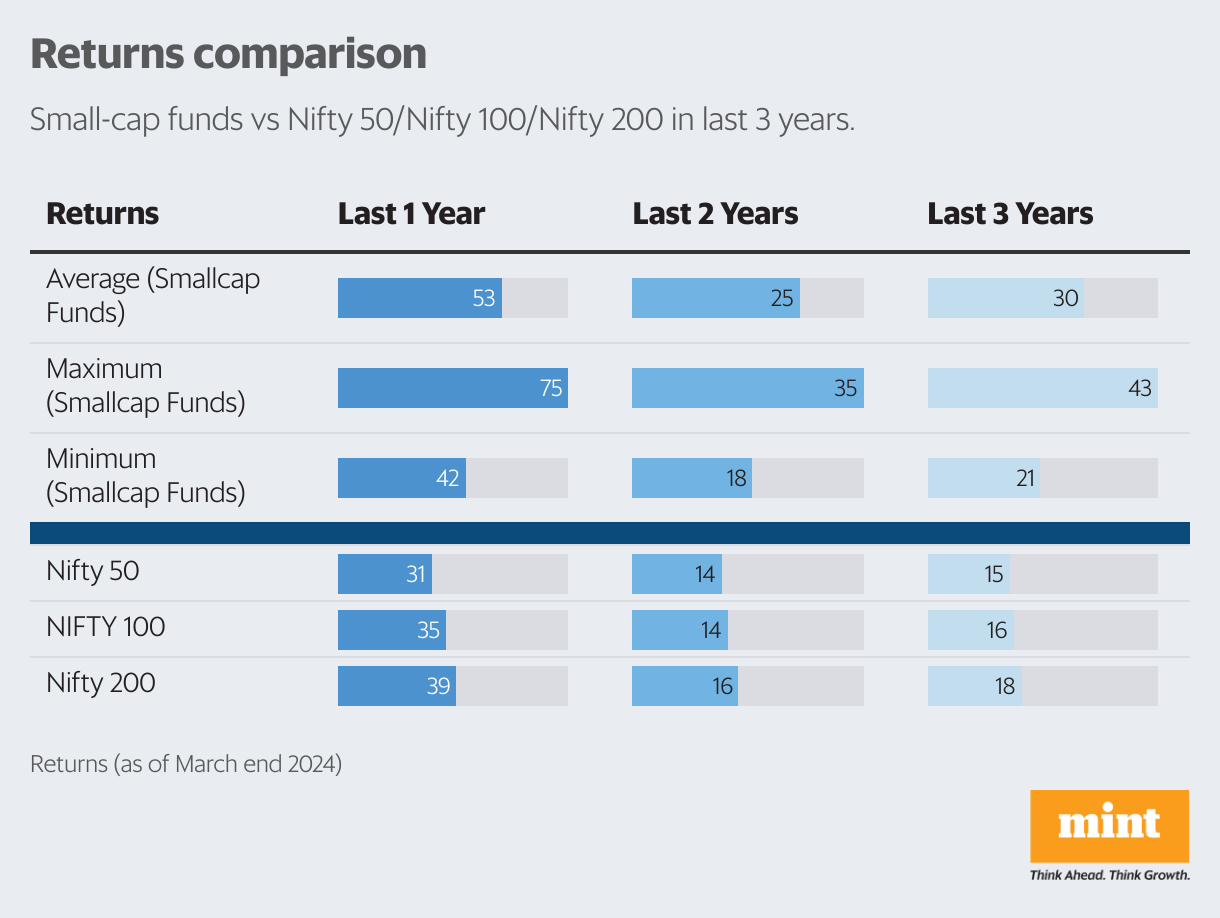
To be fair, staying in small-cap (funds) over the recent past has worked very well for investors. Here is a small aggregate data (of small-cap funds that are at least three years old) that proves this (see graphic).

Irrespective of whether you look at the data of the last one, two or three years data, even the worst small-cap funds have comfortably beaten returns given by large-cap indices like Nifyt50/100 and also large-midcap indices like Nifty200.

And this return profile of the recent past (more specifically the run-up after the pandemic bottom of 2020) has more and more people getting more aggressive with small-caps. New entrants in markets won’t acknowledge (or understand) but mean reversion is still a thing in markets. And given the structurally volatile nature of small-caps, at times, the reversion in this space can be deep and painful. Ask those who have been investing for decades and they will tell you.

This had me thinking. What is the right allocation to have to small-cap funds in a mutual fund (MF) portfolio?

Of course, the answer will vary for different individuals. But still, should one have some guiding guard rails to control the exposure? I think that is required.

Unless you are a professional investor or really have some solid insight about the space, you have no reason to be heavy on small-cap at any time. And this I say for common everyday investors.

In my unsolicited view, if you belong to the balanced or moderately aggressive investors category, then I suggest capping the exposure to small-caps to a maximum of 25-30% of the overall equity exposure.

Many of you may not agree with this view, and more so with recent data to help your case. But let’s remember that even though small-cap funds seem to offer the ‘potential’ for significantly higher future returns than, say, large-caps, they also come with much higher risks compared to large-caps or even mid-caps.

Small-cap funds are a superb choice for taking exposure to small-caps and much better (for common investors) than trying to pick small-cap stocks directly. But don’t be too greedy looking at the recent outperformance and limit yourself to 25-30% in this space. And be willing to remain invested for at least 5-7 years (longer would be better). And what if you have a lower risk appetite and consider yourself to be a conservative sort of investor? In that case, just skip small-cap funds. You don’t need them. The small equity exposure you need is best managed via large-cap funds or flexi-cap funds. That’s it.

I don’t have a crystal ball to tell you whether the ongoing party of small-caps (even after the recent small correction) is over or will still go on. But given what the space has delivered in recent times, it is definitely good to be cautious. If nothing else, I would leave you with one takeaway (that I gave earlier too), do not let your small-cap exposure go beyond 30%. In roaring bull markets, you will be tempted to do so. But it’s good to rebalance and bring it back to saner levels. And if you are still not convinced and still have a small-cap heavy portfolio, I strongly suggest you go and talk to a good investment adviser.

Dev Ashish is a registered investment adviser and founder of Stable Investor

(The views expressed above should not be considered professional investment advice or advertisement or otherwise.)

[ad_2]

Samsung Galaxy S25 Series to Run on Snapdragon and Exynos Chipsets: Report

[ad_1]

Samsung launched the Galaxy S24 series running on Snapdragon and in-house Exynos chipsets in January. The South Korean technology conglomerate was tipped last month to fully switch to Exynos SoCs for the entire Galaxy S25 lineup next year. A new report, however, contradicts the claim and says that Samsung will once again opt to split its Galaxy S25 smartphones between Snapdragon and Exynos chipsets. The company will reportedly utilise Qualcomm’s Snapdragon 8 Gen 4 and Exynos 2500 chipsets for its next generation of flagship Galaxy S series smartphones.

According to a report by DigiTimes Asia (via SamMobile), Samsung will stick with its strategy of using both Qualcomm and Exynos chipsets for its Galaxy S series smartphones. The report does not specify which phones in the lineup will run on Snapdragon 8 Gen 4, but we can expect the Qualcomm SoC to feature on the top-of-the-line Galaxy S25 Ultra in all markets. Other phones in the series — likely to be Galaxy S25 and Galaxy S25+ — could feature the Exynos 2500 chipset or Snapdragon 8 Gen 4, depending on the region where they are sold.

The Galaxy S24 Ultra runs on Qualcomm’s Snapdragon 8 Gen 3 globally, while the in-house Exynos 2400 SoC powers the base Galaxy S24 and Galaxy S24+ in markets outside the US, including India.

Last month, a rumour claimed that Samsung may use either an Exynos SoC or a Snapdragon chip, depending on the region, even on the Galaxy Z Fold 6 and Galaxy Z Flip 6 foldables. This would be a departure from Samsung’s usual practice of packing Snapdragon processors in its Galaxy Z Fold and Galaxy Z Flip smartphones.

Samsung is also working on closing the performance gap between Qualcomm and Exynos chipsets. Last week, a tipster claimed that the company’s Exynos 2500 processor outperformed the current Snapdragon 8 Gen 3 SoC in terms of both CPU and GPU performance. The claim, however, was not backed by any performance metrics and benchmark numbers.

While there are no benchmarks available yet, the Exynos 2500 chipset is said to comprise a Cortex-X5 core clocked at 3.2GHz or more, three Cortex-A730 cores at up to 2.5GHz, two more Cortex-A730 cores, and four Cortex-A520 cores with undisclosed clock speeds.

Early in March, the Galaxy S25 series was tipped to run entirely on Samsung’s Exynos chipset. Qualcomm’s Snapdragon 8 Gen 4 chipset, meanwhile, has been confirmed to launch with a custom Oryon CPU at the Snapdragon Summit in October. The chipset is expected to power upcoming flagship Android phones like Samsung Galaxy S25, Xiaomi 15 series, and Asus Zenfone 11.


Affiliate links may be automatically generated – see our ethics statement for details.

[ad_2]

Suzuki two-wheeler volumes jump 21% in FY2024, clocks highest-ever annual sales

[ad_1]

Suzuki Motorcycle India sold 11,33,902 units between March 2023 and April 2024, as against 938,371 units sold during the same period in FY2023, record

Suzuki Access 125
Suzuki closed the previous financial year on a high with a 21 per cent jump in year-on-year volumes, while sales in March 2024 increased by 18 per cent

Suzuki Motorcycle India announced its sales for FY2024 and the company registered a 21 per cent growth in the previous financial year. The two-wheeler giant sold 11,33,902 units between March 2023 and April 2024, as against 938,371 units sold during the same period in FY2023, recording its highest annual sales ever.

Out of the nearly 11.34 lakh units sold last fiscal, Suzuki’s domestic sales stood at 921,009 units in FY2024, growing by 26 per cent over 730,756 units sold in FY2023. Exports stood at 212,893 units, growing by 3 per cent when compared to 207,615 units sold in the 2022-23 financial year.

Also Read : Suzuki V-Strom 800DE Adventure Tourer launched in India, priced at 10.30 lakh

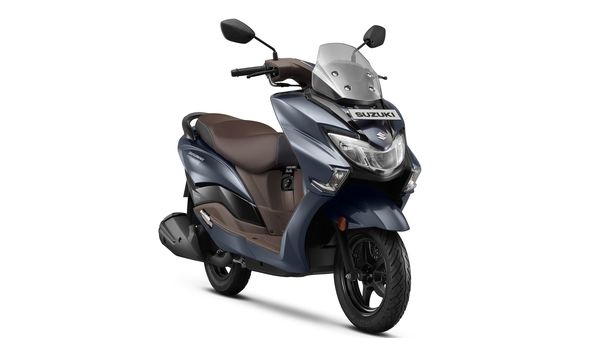
Suzuki Burgman Street 125
Suzuki’s scooter range continues to dominate its two-wheeler sales, followed by 150 cc and above mass-market motorcycles

Suzuki’s monthly sales in March 2024 remained in the green with a 6.2 per cent growth year-on-year. The company sold 103,669 units last month, as against 97,584 units in March 2023. Domestic sales in March stood at 86,164 units, registering an 18 per cent growth over 73,069 units sold in March 2023. Exports stood at 17,505 units last month, down by 28.59 per cent over 24,515 units shipped overseas in March 2023.

Speaking about the sales, Kenichi Umeda, Managing Director – Suzuki Motorcycle India, said, “We are extremely thankful to all our customers, dealer partners, suppliers and SMIPL team members for their support in achieving the highest ever sales in FY2023-24. SMIPL’s performance in FY2023-24 showcases the immense trust and confidence that customers have shown in Suzuki two-wheelers. As we continue to innovate and expand our offerings, we look forward to further strengthening our position in the Indian two-wheeler market.”

Suzuki’s majority of sales come from its scooter range comprising the Access, Burgman Street and Avenis scooters. The Gixxer 155 and Gixxer 250 series follow, while premium motorcycles including the Hayabusa and Katana bring in a handful of numbers. The Japanese two-wheeler maker recently launched the Suzuki V-Strom 800DE in the country, bringing the middleweight adventure tourer at a competitive price of 10.30 lakh (ex-showroom).

First Published Date: 03 Apr 2024, 07:20 AM IST

[ad_2]